김석훈 | 우리말 뿌리연구가, 『우리말 범어사전』 편저자
| 역사계보 족보연구가, 『천제환국조선인류역사계보 』 두루마리 편
| '다일라 운동' 주창



이것이 살아있는 고어다 — 드리다 들다 들이다
■ 1. 문제 제기
— 왜 범어 한 단어와 우리말이 이렇게 깊이 맞닿아 있는가?
우리말 들다 ·들이다·드리다는 이렇게 쓰입니다.
붙들다
손에 들다
집에 들다
세를 들어 (살다)
서예부에 들다
진리가 들어 (있다)
생각·예감이 들다
느낌이 들다
제정신이 들다
습관·버릇이 들다
철이 들다
속이 들다
물·물감이 들다
병이 들다
힘들다
고생길에 들다
잠이 들다
맛이 들다
축에 들다
맘에 들다
눈에 들다
정이 들다
볕이 들다
풍년이 들다
예를 들다
장가 들다
매·채찍을 들다
귀신·빙의 들다
계를 들다
도둑이 들다
정성·공을 들이다
사람·파출부를 들이다
(밭에) 씨를 들이다
합의를 받아들이다
보험에 들다
말씀을 드리다
선물을 드리다
애가 들어서다
서로 전혀 다른 뜻처럼 보이는 이 말들은
실제로는 하나의 구조로 이어진다.
놀라운 점은
이 모든 의미의 흐름이
산스크리트어(범어) 어근 dhṛ [드리]가 보여 주는 의미 구조와
정확하게 대응된다는 데 있다.
■ 2. 모니에 윌리엄스 범영사전의 핵심 어근
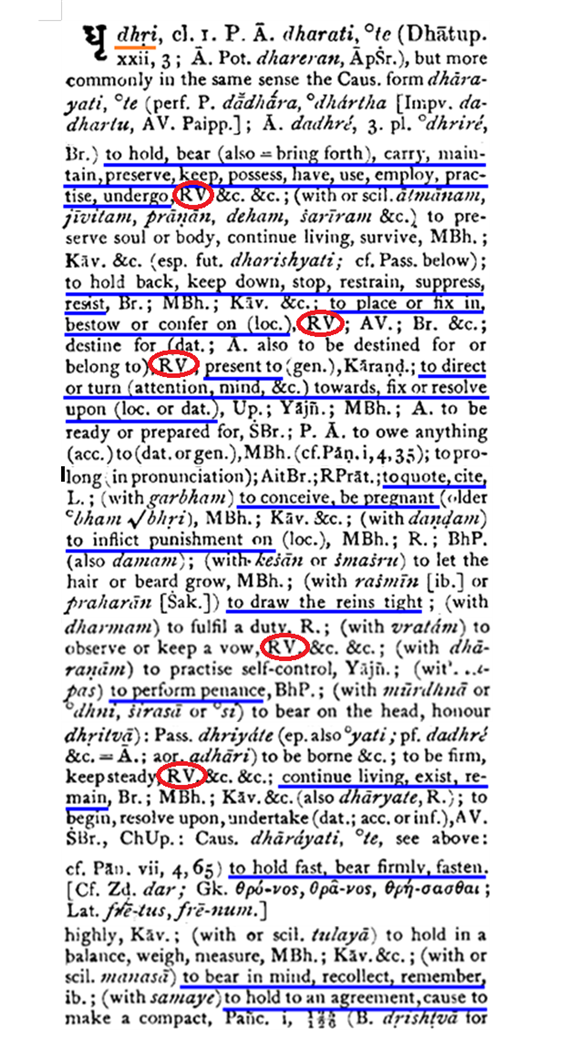
dhṛ = dhR^i [드리] *
* 표기방법이 다를뿐 발음은 같다.
Monier-Williams, A Sanskrit–English Dictionary (1899), 519쪽
모니에 윌리엄스 사전에서 dhṛ [드리]는 다음처럼 풀이된다.
바로
“무언가를 안으로 받아 붙들고, 그 상태를 유지하며, 그로 인해 어떤 작용이 일어나는 것” 이다.
이 어원이
지금도 우리 삶속에 생활어로 살아 있다는 점은
매우 주목할 만하다.
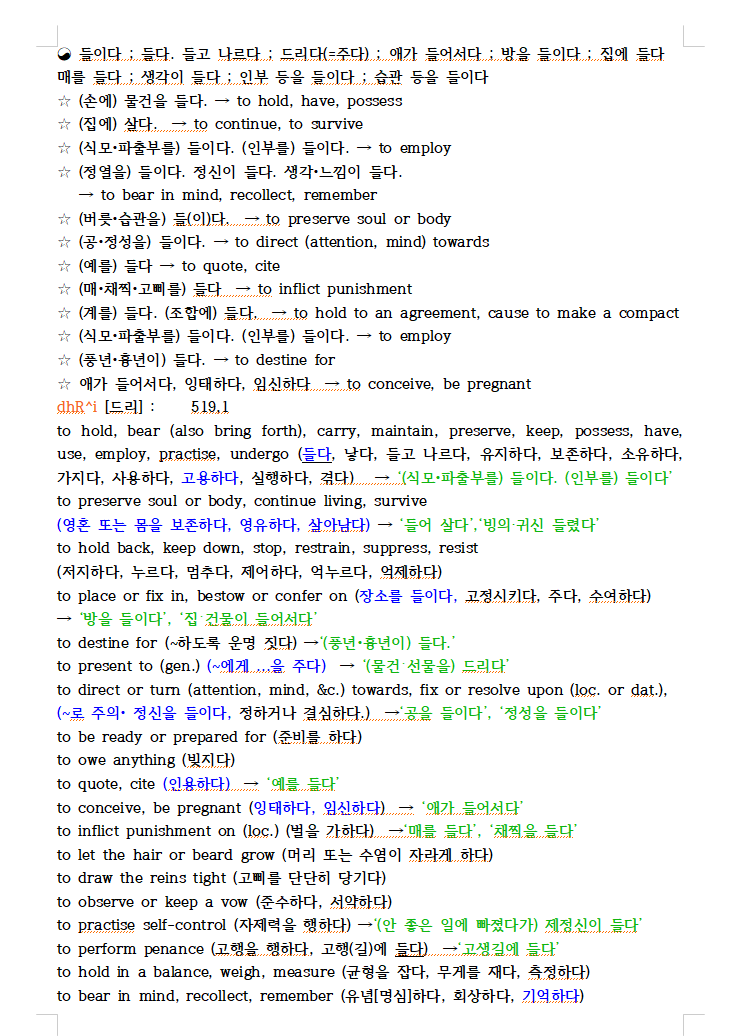
2-1. dhṛ [드리]
• hold, have, possess (붙들다, 소유하다) → 손에 들다, 물건을 들다
• place or fix in → ‘방을 들이다’, ‘집・건물이 들어서다’
• bear in mind, recollect, remember (명심하다·기억해 내다) → 생각이 들다
• carry (나르다) → 들고 나르다
• preserve soul or body, continue living, survive (영혼 또는 몸을 보존하다, 영유하다, 살아남다)
→ ‘들어 살다’,‘빙의·귀신 들렸다’
• preserve (보존하다) → 습관이 들다
• employ (쓰다·고용하다) → 사람을 들이다
• direct (attention, mind) towards (향하게 하다) → 정성을 들이다
• quote (인용하다) → 예를 들다
• conceive ,be pregnant (잉태하다) → 애가 들어서다 to conceive, be pregnant
• present (주다) → 말씀을 드리다, 선물을 드리다
• inflict punishment on (처벌하다) → 매를 들다, 회초리를 들다
• perform penance (고행하다) →고생길에 들다
• hold to an agreement, cause to make a compact (협약하다) →계를 들다
•destine for (~하도록 운명 짓다) →‘(풍년•흉년이) 들다.’
▶ 이 어근의 중심에는
들어옴, 붙듦, 유지, 작용, 전달이 함께 들어 있다.
2-2. dhā [드하]
• to place, put (두다) → 방을 들이다, 물건을 들여놓다
• to fix in (자리잡게 하다) → 집이 들어서다
• to bestow (주다) → 드리다
▶ 자리잡음 + 부여 + 정착
■ 3. 또 다른 '들다·들이다'
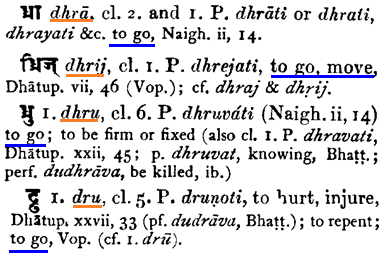
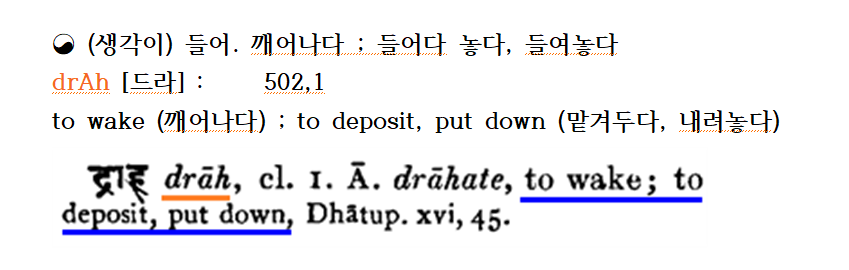
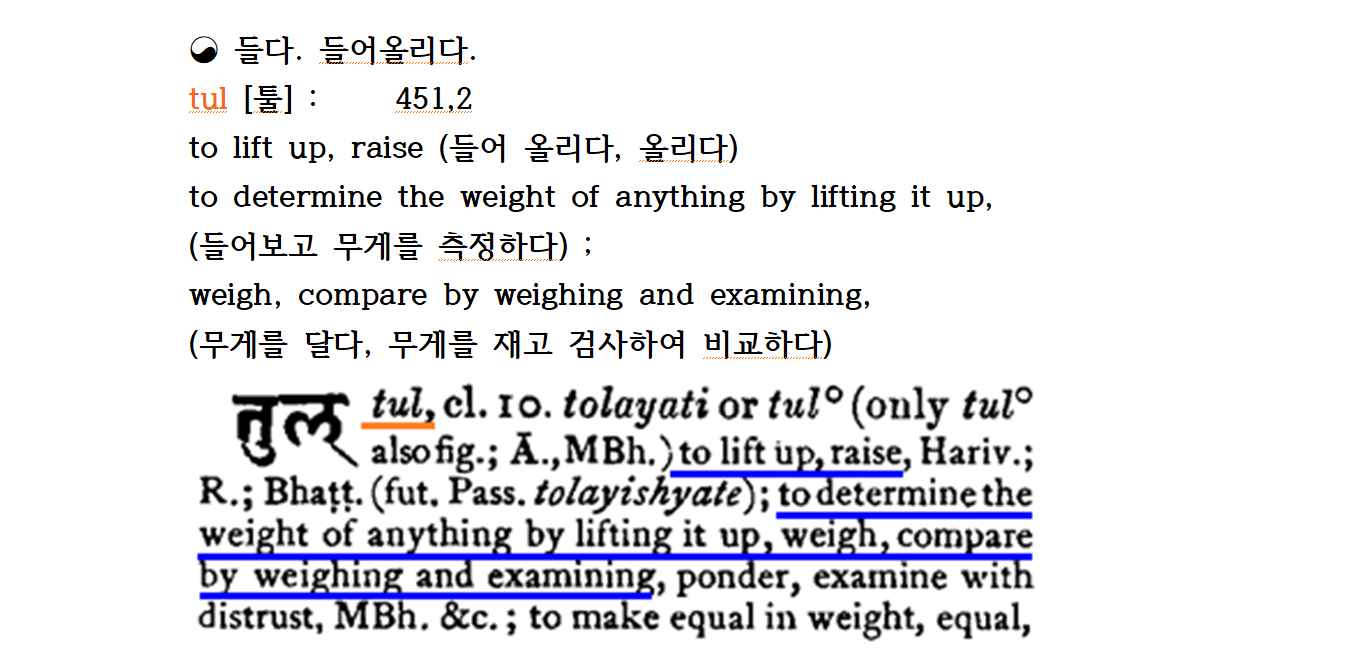
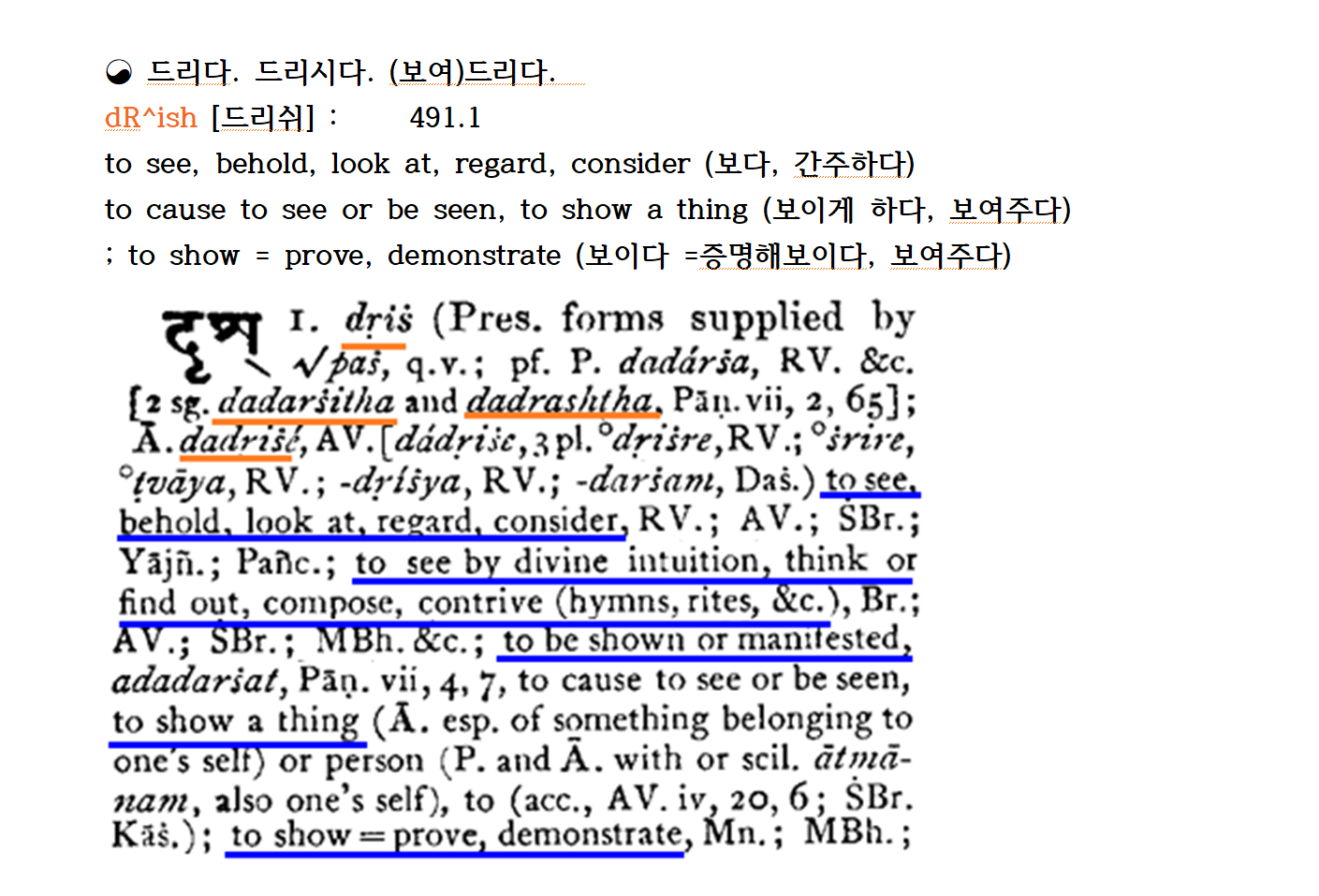
▶ dhru / dhṛj / drāh / tul / dur / dṛś / dṛ / druD / duur
핵심이다.
이 어근들은 각각
▶ 붙듦 / 자리잡음 / 이동 / 진입 / 깨어남 / 들어올림 / 경계 / 보여줌 / 분리 / 가라앉힘 / 호흡
이라는 서로 다른 의미 영역을 갖고 있음에도 불구하고,
우리말에서는 이 모든 의미가
▶ 단 하나의 말 ‘들다·들이다·드리다’로 통합되어 사용된다.
3-1. dhru / dru [드루]
• to go (가다) → 집에 들다, 안으로 들어가다
• to move (움직이다) → 들락거리다
▶ 이동, 진입
3-2. dhṛj [드리지]
• to go, move → 들어가다, 들다
▶ 움직이며 안으로 들어감
3-3. drāh [드라]
• to wake (깨어나다) → 정신이 들다
• to deposit (놓다) → 들여놓다
▶ 내부 변화 + 자리잡음
3-4. tul [툴]
• to lift up (들어 올리다) → 물건을 들다, 들어올리다
• to weigh (무게를 재다) → 들어보고 판단하다
▶ 들어올림 + 판단
3-5. dur / duroṇa [두르]
• door (문) → 들어오다, 들락날락하다 / (문·방안으로) '들온나·드론나' (남도 사투리) *
• residence (집) → 집에 들다
▶ 경계 + 안과 밖
※ 이 어근은
영어 door(문)와도 형태와 의미에서 밀접하게 대응되며,
넓은 인도·유럽 어원 계열 속에서 함께 이해될 수 있다.
3-6. duur [두르]
• vital breath (생명의 호흡) → 숨을 들이마시다
▶ 호흡, 생명 유입
3-7. dṛś [드리쉬]
• to show (보이다) → 보여드리다
▶ 보이게 하여 전달
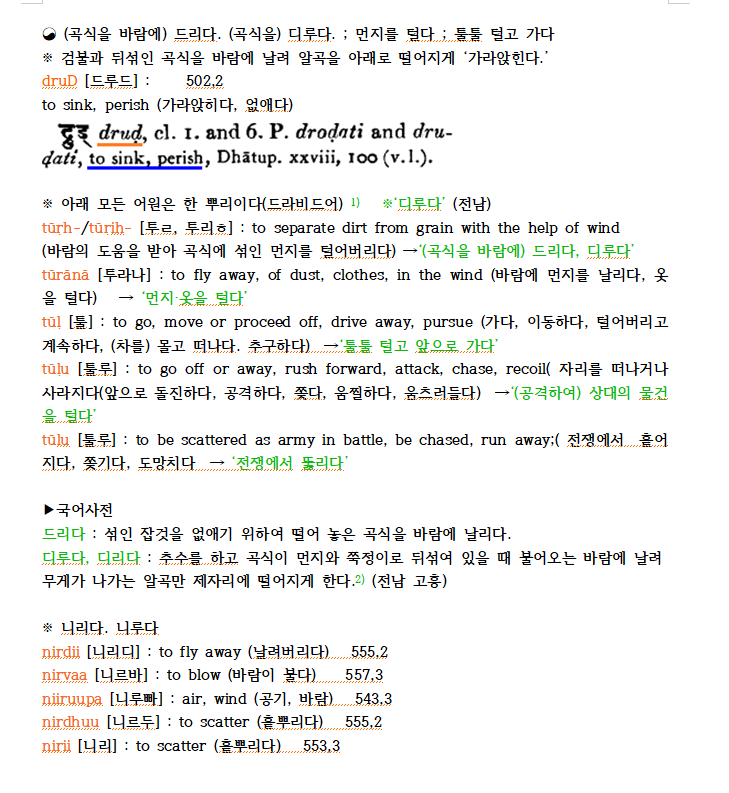
3-8. druD / dṛ [드루드 / 드리]
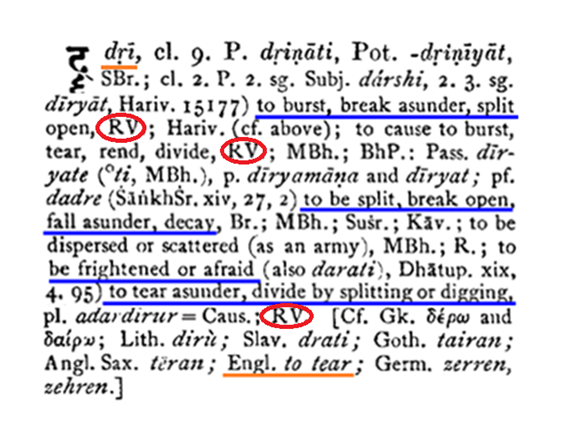
• to sink (가라앉히다) → 곡식을 드리다
• to split, tear (쪼개다) → 뜯다, 부수다 → (칼·낫이) 잘 들다
▶ 분리, 제거, 정리
‘들다’는 단순히 들어오는 것이 아니라
안으로 들어와 자리잡고, 유지되며, 작용하는 구조를 가진다.
그리고 ‘들이다’는
그 과정을 의도적으로 일어나게 하는 작용이다.
■ 4. 정리
우리말 들다·들이다·드리다는 겉으로는 뜻이 매우 많아 보이지만,
그 밑바닥에는 공통된 구조가 놓여 있다.
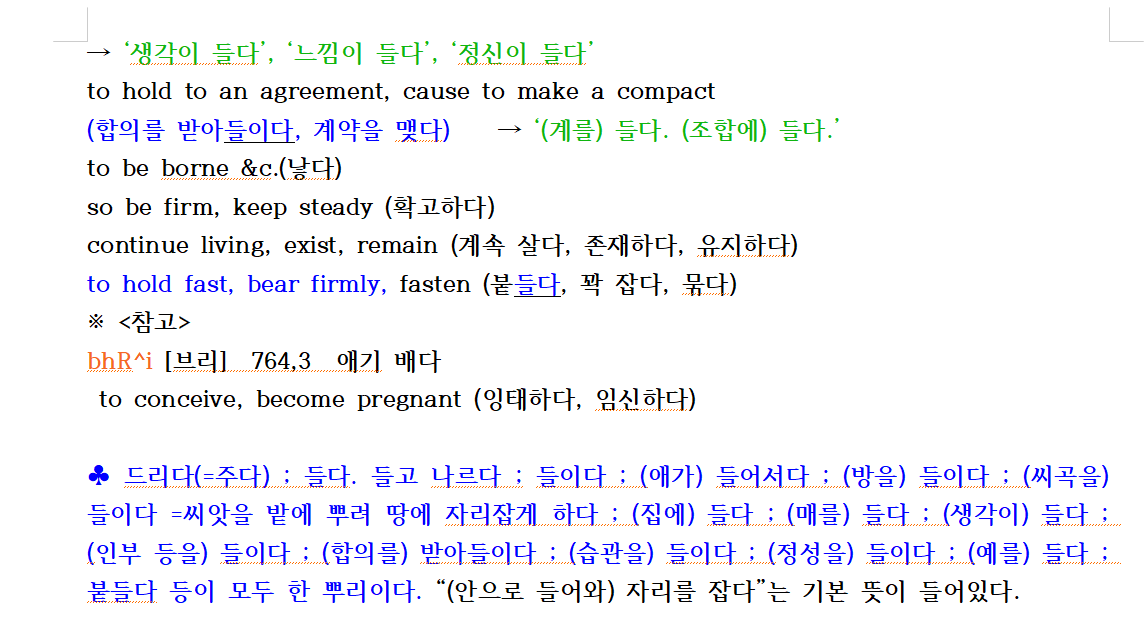
그 구조는 “무엇이 안으로 들어와 자리를 잡고, 유지되며, 작용하게 되는 것”이다.
모니에 윌리엄스 범영사전의 √dhṛ(드리)는
hold, bear, carry, maintain, preserve, possess, employ, direct, quote, conceive, present와
같은 뜻을 가지는데, 이는 우리말
손에 들다, 집에 들다, 사람을 들이다, 정성을 들이다, 예를 들다, 애가 들어서다, 말씀을 드리다와
놀랄 만큼 넓고도 구체적으로 대응한다.
따라서 ‘들다’ 계열은 단순한 다의어가 아니라,
“들어옴–자리잡음–유지–작용–전달”이라는 하나의 뜻줄기를 가진 말로 이해할 수 있다.
■ 5. 더 깊은 질문 — 사람과 언어의 내부화
이 글에서 가장 중요한 대목은 바로 이것이다.
오늘날 인도에서 산스크리트어는 생활어로 거의 쓰이지 않지만,
그 핵심 어근과 의미 구조가
멀리 떨어진 한반도에서
지금도 일상의 말로 살아 움직이고 있다는 점이다.
특히 더 주목해야 할 것은 거리의 문제가 아니다.
인도와 한국 사이에는
거대한 중원, 중국이 자리하고 있다는 사실이다.
그럼에도 불구하고
왜 그 언어층은
중간에서 끊기지 않고
오히려 한반도의 삶 속에
이처럼 세밀하게 스며들어 있는가?
그것도 몇몇 종교 용어나 학술어가 아니라,
손에 쥐고
집 안으로 들어가고
마음속에 떠오르고
몸에 배고
삶의 형편으로 굳어지고
정성을 쏟고
사람을 받아들이고
말과 마음을 건네는
생활 전체의 언어 구조로 남아 있다는 점이다.
이 현상은 단순한 차용이나 우연한 유사성으로 보기 어렵다.
또한 특정 시기의 문화 전래만으로 설명하기에도 부족하다.
오히려 이것은
인도, 중앙아시아, 동아시아를 가로지르는 넓은 공간 속에서
우리 선조들이 수천 년 동안 이동하고 삶을 이어가며
밖의 것을 받아들이고
그 안에서 삶을 이루어 온 방식 자체가
언어로 남은 결과일 가능성을 시사한다.
※ 주(註)
빨간 원(圓)안 에 표시된 RV는 약 3,500년 전의 인류 최고(最古) 문헌인
리그베다(Rigveda)에 기록된 용례를 의미한다.



●스스로 "나"를 사랑하고, 우리말과 역사를 사랑하는 모든 사람들에게 전달해 주십시오.
위 내용은 인터넷 주소창과 카톡에 아래와 같이 바로 입력하여 볼 수 있습니다.
www.다일라.한국/63
www.다일라.한국/62
이것이 살아있는 고어다 — 이 사진들의 공통점은 무엇일까?
이것이 살아있는 고어다 — 이 사진들의 공통점은 무엇일까?
김석훈 | 우리말 뿌리연구가, 『우리말 범어사전』 편저자 | 역사계보 족보연구가, 『천제환국조선인류역사계보 』 두루마리 편 | '다일라 운동' 주창 이것이 살아있는 고어다— 우리말 ‘타다
www.xn--2j1b40gc5q.xn--3e0b707e
www.다일라.한국/61
다일라! - 대한민국 정신적 좌표
김석훈 | 우리말 뿌리연구가, 『우리말 범어사전』 편저자 | 역사계보 족보연구가, 『천제환국조선인류역사계보 』 두루마리 편 | '다일라 운동' 주창 다일라!!! 다 + 일라 다 깨어 일어나라 세종
www.xn--2j1b40gc5q.xn--3e0b707e
◈ ◈ ◈ ◈ ◈ ◈ ◈ ◈ ◈ ◈ ◈ ◈ ◈ ◈ ◈ ◈ ◈ ◈ ◈ ◈ ◈ ◈ ◈ ◈ ◈ ◈ ◈ ◈ ◈ ◈ ◈ ◈
Kim Seok-Hoon
Korean Etymology Researcher
Editor of Our Korean–Sanskrit Etymological Dictionary
Genealogical & Historical Lineage Researcher
Compiler of the scroll The Genealogical History of Humanity from the Heavenly Emperor Hwan-State and Joseon
This Is a Living Ancient Language
— The Linguistic Structure Preserved in Korean deulda · deurida · deurida
■ 1. Problem Statement
— Why does a single Sanskrit root resonate so deeply with Korean?
In Korean, the verbs deulda, deulida, and deurida are used in the following ways:
to hold
to carry in the hand
to enter a house
a thought arises
a feeling arises
to come to one’s senses
a habit forms
to fall ill
to fall into hardship
a good harvest occurs
to give an example
to raise a whip
to be possessed
to join a group
to devote effort
to take someone in (e.g., a worker)
to sow seeds
to accept an agreement
to offer words
to present a gift
to conceive a child
At first glance, these meanings seem completely unrelated.
Yet in reality, they are connected through a single underlying structure.
What is remarkable is that
this entire flow of meanings
closely corresponds to the semantic structure
of the Sanskrit root dhṛ [dhri].
■ 2. The Core Root in Monier-Williams Dictionary
dhṛ = dhṛi [dhri]
(Different notations, same pronunciation)
Monier-Williams, A Sanskrit–English Dictionary (1899)
In this dictionary, dhṛ is defined as follows:
“To take something in, hold it, maintain it,
and from that state, produce an effect.”
The fact that this root
still lives on in everyday Korean
is highly noteworthy.
2-1. dhṛ [dhri]
• hold, have, possess → to hold in the hand, to hold an object
• place or fix in → “to set up a room,” “a house or building comes into place”
• bear in mind, recollect, remember → a thought arises
• carry → to carry while holding
• preserve soul or body, continue living, survive
→ “to live on,” “to be possessed (by a spirit)”
• preserve → a habit forms
• employ → to take someone in (e.g., a worker)
• direct (attention, mind) towards → to devote effort or attention
• quote → to give an example
• conceive, be pregnant → to conceive a child
• present → to offer words, to present a gift
• inflict punishment on → to raise a rod, to administer punishment
• perform penance → to enter into hardship
• hold to an agreement, cause to make a compact → to join or form an association
• destine for → “to be destined (e.g., a good or bad harvest occurs)”
▶ At its core, this root contains:
entering, holding, maintaining, acting, and transmitting
2-2. dhā [dha]
• to place, put → to bring something in
• to fix in → to establish
• to bestow → to give
▶ settlement + placement + bestowal
■ 3. Additional Roots Related to deulda
▶ dhru / dhṛj / drāh / tul / dur / dṛś / dṛ / druḍ / duur
Each of these roots carries meanings such as:
▶ holding / settling / movement / entering / awakening / lifting / boundary / showing / separating / sinking / breathing
Yet in Korean, all these meanings
are unified within a single verb system:
deulda · deulida · deurida
3-1. dhru / dru
• to go → to enter a place
• to move → to go back and forth
▶ movement, entry
3-2. dhṛj
• to move, go → to enter
▶ motion into an interior
3-3. drāh
• to awaken → to regain consciousness
• to deposit → to place inside
▶ internal change + settlement
3-4. tul
• to lift → to raise
• to weigh → to judge
▶ lifting + evaluation
3-5. dur / duroṇa
• door → to enter, to go in and out
• residence → to dwell
▶ boundary between inside and outside
※ This root also shows notable correspondence in form and meaning
with the English word door,
suggesting a broader Indo-European connection.
3-6. duur
• vital breath → to inhale
▶ breath, life entering
3-7. dṛś
• to show → to present
▶ making visible, transmitting
3-8. druḍ / dṛ
• to sink → to settle
• to split → to separate
▶ separation, refinement
Thus, deulda is not simply “to take in,”
but a process of entering, settling, sustaining, and acting.
And deulida
is the intentional act of making that process happen.
■ 4. Summary
Although deulda · deulida · deurida
appear to have many different meanings,
they are built upon a single underlying structure:
Something enters, settles, is maintained, and produces an effect.
The Sanskrit root dhṛ encompasses meanings such as
hold, bear, carry, maintain, preserve, employ, direct, quote, conceive, and present.
These correspond strikingly and concretely
to Korean expressions such as:
to hold in the hand
to enter a house
to take in a person
to devote effort
to give an example
to conceive
to offer words
Thus, the deulda system
is not a collection of unrelated meanings,
but a unified semantic flow:
entering → settling → maintaining → acting → transmitting
■ 5. A Deeper Question — Internalization of Language
This is the most crucial point of the discussion.
Although Sanskrit is no longer widely used
as a spoken language in India today,
its core semantic structures
continue to live on
in everyday Korean.
What is even more striking
is not merely the geographical distance,
but the fact that
between India and Korea
lies the vast cultural sphere of China.
Yet despite this,
why does this linguistic layer
not fade or fragment along the way,
but instead remain
so intricately embedded
in the daily language of the Korean Peninsula?
Not as a few religious or scholarly terms,
but as a structure governing everyday life:
holding things
entering spaces
forming thoughts
developing habits
shaping life conditions
devoting effort
accepting people
and conveying words and emotions
This phenomenon
is difficult to explain
as simple borrowing or coincidence.
Nor can it be fully accounted for
by limited cultural transmission.
Rather, it suggests that
across the vast regions of India, Central Asia, and East Asia,
as our ancestors moved, settled, and lived,
the very way they received the outside world
and built life within it
became embedded in language itself.